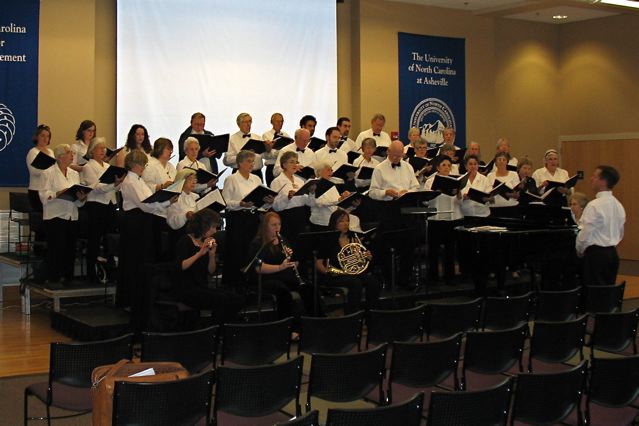
("Homeland Suite" © Kathleen Pierson 2008, contact Kathleen for permission to re-post or otherwise re-use or distribute)
Chuck Taft conducting, Nora Vetro piano.
Need the QuickTime player? Download it Here, for free
After the May 4th performance, one of the choristers e-mailed Kathleen to say:
Kathleen says, to any chorus or choir thinking of possibly performing this piece: In support of it receiving additional performances, copies of the music can be had for just the cost of the photocopying, and can be re-arranged (for example, without the instrumental parts; for all-women; etc) at no cost, and can have my help in rehearsal or conducting if desired for free in Asheville region, or for just the cost of travel/ lodging if more than an hour from Asheville. Contact kathleen -at- kathleenpierson -dot- com, or kashainwords -at- gmail -dot- com or PO Box 18022, Asheville, NC 28814.
© Kathleen Pierson 2008
Kathleen says: After many years of visiting North Carolina, I finally officially moved here to Asheville in September 2007. I saw a notice mentioning that the combined Reuter Center Singers and UNCA Chorus (along with additional forces) would be performing the 2-piano/ percussion version of Orff's "Carmina Burana" at UNCA in October. Carmina is one of my all-time favorite choral works, so I "joined up" and began rehearsing with BOTH choruses. It was thrilling. I have loved choral singing since childhood, but due to work-schedule conflicts in my previous Ohio situation, I hadn't been able to sing with any chorus for years. The remembrance of the pleasure of being "an alto amongst altos" was a wonder in and of itself, and then the excitement of the successful Carmina performance was just amazing. What a way to spend my first weeks in Asheville!
Chuck Taft (director of Reuter Center Singers) heard that Carmina (in its orchestral version) had been one of my graduate school "study pieces," and he asked about my background. Once he found that my degree is in composition, he asked to see examples of my work. I brought in a bit of my choral writing and some art songs for him to look at.
Late in October, Chuck approached me about composing something "big" specifically for the Reuter Singers' spring '08 "Patriotism" concert. At first, I wasn't sure what to make of the patriotic theme, but Chuck encouraged me to approach the concept of patriotism/ homeland/ etc in my own personal ways, and so I agreed to try. Logistically, there were several challenges - for instance, I had no piano, but I would need one to work with. Chuck arranged for me to have access to a beautiful piano. And (being no longer affiliated with a computer-lab equipped academic music department), I did not have the music-printing software to make a professional-looking score. Chuck accepted my old-fashioned hand-written pages.
My background/ influences/ training have been wildly eclectic. I still love singing alto on the hymns of childhood and the choral masterworks I first encountered in school, but I also "do" electronic music, pop music, etc. I studied for awhile with Robert Hall Lewis, a Milton Babbitt protege. I worked on electronic composition with Dale Millen. I admired rule-breaker American composers like Ives, Cage, Oliveros. I studied with Lawrence Crawford, whose love of Mozart AND Cage, and Debussy and Ginastera and other more mystical composers, made me hear things afresh, in midlife. Meanwhile, for decades, I worked composing and improvising in minimalist/ new-age idioms for modern dance choreographers, and meanwhile I was accompanying thousands of hours of traditional ballet classes. I was even breifly involved in writing and directing children's musicals, and composing filmic electronic scores for theatre productions at The Globe in L.A. And I (even now, at "my age"!) still sometimes gig as a Joni-Mitchell-esque singer/songwriter, as I have enjoyed doing since my college days. And I wanted to be open to the possibility of any and all of these myriad influences working their way into this new composition, everything from the serious historic and modern composers to the childhood hymns to the conversational styles of musical theatre and of my singer/songwriter idiom.
It had been years since I had been given the opportunity to work on something of this scale. My mind overflowed with the possibilities...
As I set to work, my approach was three-fold:
First, I did a LOT of reading in a very short time, wide-ranging reading of everything from online blogs and philosophical ramblings (googling the word "homeland" yieds over 40 million results), to old books like Toffler's "War and AntiWar" and Rybczynski's "Home; A Short History of an Idea" (which seems on the surface to be about architecture and design, but includes fascinating discourses on things like how the world is divided along the lines of those who sit in chairs and those who do not, the roots of our "chairman" concepts). I looked at Wikipedia's intriguing article about the controversy surrounding the "ecology speech" attributed to Chief Seattle. I looked at some of Bush's speeches since 9-11. I needed to just THINK about what "homeland" might even mean, to me.
Meanwhile, I began researching the national anthems of other countries, pondering the fact that each nation hopes to build a sort of group loyalty and collective emotional attachment, but some take on adversarial tone while others (Australia for example, "We've boundless plains to share!") taking a more invitational or (Estonia, "My native land, my pride and joy") devotional tone. I needed to just THINK about what "patriotic music" was, in the most general terms.
Finally, I set about scribbling notes on staves, shaping the over-all design and sketching out musical and textual ideas. The work was going to be big enough to require a very patient "work and re-work" approach, and complex enough to require something of a "puzzle-solving" mindset. I knew I wanted it to feel like one whole thing, in the end, but it would need vivid shiftings and musical contrasts along the way...
Of course, Chuck wanted to have at least a LOOK at a rough draft, to see if things were looking promising or not! On Nov 12th 2007 I showed him a rough draft of the first section, plus most of the third section, and a slight indication of plans for the contrasting middle section. It had only been about seven weeks since Chuck and I had first met! And just two weeks since I had embarked on this project. He encouraged me to keep working on it...
Meanwhile, I was enjoying our weekly rehearsals, as we prepared for our series of seasonal-music performances, fast approaching in the short span between the October 28th Carmina performance and the soon-upon-us holiday season...
After Thanksgiving, Chuck and I had another meeting and he gave me some very specific feedback, pushing me to be less pedantic about some of the text-setting, and to remember to make use of the time-honored choral techniques of repetition and representation, etc. He also encouraged me to include instruments in the score! Instruments?! Where was he going to get instruments? "You let ME worry about that" he said - a mantra to be oft-repeated over the next five months. It's not easy to not worry about things like that! He also convinced me to treat the middle section of the work more fully (and not just leave it as rhythmically-spoken text, which it was at that point, but instead commit to pitch choices and harmonic choices) - which led to a general expansion of my entire concept of that middle section.
As part of my whirlwind month of attending every choral performance of the winter season (I heard three choral concerts in one day, one December Sunday!) and having enjoyed hearing choruses singing Britten, Durufle, Ritter (with antiphonal brasses!), etc etc etc, at so many different beautiful venues all over town (is there any other city with as much great music per capita as Asheville??), on Dec 9th I heard Asheville Choral Society for the first tme, performing some of the most magnificently-composed choral compositions I'd heard in years, including two pieces by Z. Randall Stroope which not only moved me to tears but ended up infusing my own composition with a burst of fresh energy. My printed program from that concert had my excited "musical insights" scribbled in all its margins!
Meanwhile, I had signed out the Stiller orchestration tome from the UNCA library to have on hand for reference, and was wildly hurrying to somehow get the instrumental parts (and the new insights I'd gleaned from listening to the Stroope etc), worked into my score in time.
Formally writing out the pages was time-consuming (it takes about an hour a page, if there are no complications or major mistakes made) (in the end, not counting all the rough drafts from November and December, the final version is 42 pages - 21 sheets photocopied front and back).
In January, our intrepid accompanist, Nora Vetro, played through my pages for the first time, as I sang the melodic lines the best I could and Chuck followed along in the almost-finished score. I still was having trouble deciding about how to end Part 3. But it HAD to be "done," it had to get into the hands of the chorus! This gave me my first wave of deep panic, feeling like there hadn't been enough time for me to quite get it right (and indeed, if it ever has a second performance, there are myriad tiny changes and corrections I would make in the score, particularly in some of the transitions). But I always have that panic at deadlines!
After the winter break, rehearsals for the May concert began in mid-January, with my piece in the folders ready to go. Chuck carefully introduced the most accessible sections of my piece bit by bit (as we also worked on a daunting stack of about sixteen other patriotic/ homeland pieces!). I had the uncanny experience of realizing I'd never really "learned" my own alto line, in my own composition, and would have to studiously learn it just like the other altos! I also felt how different it was to be JUST "an alto" and not "the director" - I had always directed performances of my previous choral compositions myself. A very interesting sensation, to be IN the chorus, "just singing," in my own piece.
It was slow going, despite Chuck's gifted leadership. Some sections seemed much trickier for the chorus than I had expected. My harmonic language is not always traditional. I use modes, and I jump into new key signatures all at once, like a kaleidoscope turning. It makes sense to ME, but proved challenging in rehearsal. I use the interval of "major second" as a consonance, like Balkan cultures do, rather than as "a dissonance awaiting resolution." My rhythms are often shifting or syncopated. My text is not a standard poem (such as the Whitman text of the Hanson "Song of Democracy" that we were also rehearsing). All these things heightened the sense that the piece might be more difficult than I had anticipated. If it ever has a second performance, the next chorus learning it will have a huge advantage, being able to hear this chorus' performance of it and knowing how it will ultimately sound.
Once we had "gotten a handle" on the more straight-forward parts of my piece, and were finally down to the probably-most-challenging parts, indeed, some choristers were completely uncomfortable. There were objections to the text, to the music, to the underlying sentiments. There was one rehearsal where what I had thought was my "peace piece" ended up causing outright turmoil. I thought, after that rehearsal, that the entire piece had better be withdrawn, scrapped, in light of the divisive feelings it seemed to have stirred up.
Chuck pressed on. Eventually, the piece finally began to feel "familiar." Not as familiar as The Star Spangled Banner or Let There Be Peace On Earth! But less "weird," week by week. The first and third sections of it were included in two of our community performances off-campus in April, and went well. At the last moment, May 3rd, the instruments were added in. And then, the official premiere of the entire thing, in the formal "Patriotism: An American Odyssey" concert May 4th at the Reuter Center...
So that was MY odyssey, in composing this piece.
Thoughts about "composing" in general: I'm always a little sad that our culture has reached the point where "composing for ensembles/ chorus/ orchestra" seems like such a rare and peculiar activity. Those few of us who still undertake such endeavors work in ever-increasing isolation. You probably personally know visual artists, you probably know writers and perhaps even a choreographer, but how many of your friends are composers, beyond the scale of self-performing singer/songwriter? If we composers dream up large-scale ideas, it is so rare to fall into the opportunity for actual performance. It requires a very patient and dedicated chorus and conductor to make a work like "Homeland Suite" come true! The days of freshly-composed music for every occasion are long-gone, and instead of fresh music for, say, a daughter's wedding, one expects the Mendelssohn/ Wagner "standards." It is hard to realize that of course they too were once brand-new works. But after the Romantic-era waves of "composer as heroic individual" (versus the "composer as skilled craftsman" Renaissance/Baroque/Classical eras), the very idea of "composing" has died down. Even excellent college-graduate professional musicians often go through their entire schooling without ever once having composed any original work (in contrast to, say, art or literature students, who have been making original artworks/ writings since childhood and are matter-of-factly required to produce original works as the core of their educational program).
This commission, writing this big work for Reuter Center Singers, was an unexpected "opportunity of a lifetime," for me, and...
to SO MANY people. I want to begin by thanking Ann Bass and all the people of the North Carolina Center for Creative Retirement at Reuter Center, for making me feel so immediately welcome when I first moved to Asheville last Fall and for hosting the Reuter Center Singers and just generally providing a focal point for countless excellent events.
I thank the folks at the (Merrimon Avenue) Asheville Arts Center for also providing a focal point for great events in Asheville, but most specifically for allowing me to use their beautiful piano to work on this composition.
I know how corny this sounds, but I thank Asheville, the whole city, just for being as lively and engaging as it always is. Creativity is easier in places where it's not seen as being weird. I am privileged to be "one artist among MANY" in this town. I do suspect that Asheville might have the highest number of musicians per capita of any city in America. I feel very lucky to be here.
I ETERNALLY thank the chorus for their collective patience and tolerance, to work so hard and so long on such challenging music. I hope it was somehow "worth it." A composer has no way of expressing big ideas, without the help of some ensemble crazy enough to make it come true, and I am sure I speak for all choral composers everywhere when I say Thank You Thank You Thank You to choruses so bold as to premiere brand new works.
(I especially thank The Altos. To readers who are not singers, all I can say is, there is just something really fabulous about being "an alto amongst altos," and this is an especially fun bunch of altos!)
I thank Nora Vetro, our accompanist, without whom of course the piece could never have happened, who persisted - despite (I am sure) wondering, along the way, whether the whole piece was even possible!
I thank the Board of Reuter Singers, for supporting this project. And I thank CHUCK TAFT, our director, without whom the very idea for "Homeland Suite" would certainly never have occurred in the first place, whose calm persistence kept everyone willing to "try one more time" to get it all just right, and whose youthful enthusiasm infuses everything he undertakes. Of course, if my hairs weren't already all grey, I'd've "gone grey" in the course of this project! Composing/ rehearsing/ performing are more stressful than Chuck lets on! But what a great project, what an unexpected opportunity and challenge for me, as a newcomer here in Asheville. In deepest gratitude,
Kathleen "Kasha" Pierson, May 4th 2008, Asheville, NC
kathleen -at- kathleenpierson -dot- com